RidhunKathak & Dance
कथक की कहानी

The story of Kathak

From travelling storytellers to the courts of the Mughals and the Nawabs of Lucknow, and on to the concert stages of today. This is how Kathak, and the Lucknow gharana that Ridhun teaches, came to be.

Ancient rootsThe storytellers

Born from a story

Kathak takes its name from the Sanskrit word katha, meaning story. Its roots lie with the kathakars, travelling storytellers of northern India who brought the great epics to life with music, mime and gesture.

The Natya Shastra, the ancient treatise on the performing arts attributed to the sage Bharata, is the earliest surviving text with Kathak's roots. Its first complete compilation is dated to between about 200 BCE and 200 CE, and it already sets out the ideas of rhythm, gesture and expression that a Kathak dancer still works with.

कथा कहे सो कथक कहावे The one who tells a story is called Kathak.

Every Kathak performance still keeps this storyteller's heart: pure rhythm and footwork sit side by side with abhinaya, the art of telling a story through the face, eyes and hands.

Bhakti movementKrishna and devotion

The stories of Krishna

As the Bhakti movement spread devotional poetry and song across northern India, Kathak took in the stories of Krishna: his childhood, Radha and the gopis, drawn from texts such as the Bhagavata Purana.

In the Braj region around Mathura, the raslila joined music, dance and narrative, and the mime and gestures of the kathakars grew into dance. Krishna's stories are still at the heart of Kathak abhinaya today.

16th and 17th centuriesThe Mughal courts

From temple courtyard to palace durbar

Under the Mughal emperors, notably Akbar, Kathak moved from temple courtyards into the palace durbar. Performing for the court asked for refinement and display.

Persian and Central Asian influences arrived, including whirling that echoed the Sufi dervishes, and new elements of costume. The fast spins that became Kathak's chakkars, the flared angarkha and the churidar all carry the memory of this period.

Mughal miniature painting: dancers in flowing skirts perform before Emperor Akbar and his court, with musicians
Dancers perform for AkbarAkbarnama, about 1590. View on Wikimedia Commons
Dancers from Malwa perform at Akbar's court, an event of 1561, painted for the Akbarnama around 1590. Unknown artist. Victoria and Albert Museum. Public domain, via Wikimedia Commons.
18th and 19th centuriesLucknow and the Nawabs of Awadh

The court of Wajid Ali Shah

As Mughal power faded, many artists moved from Delhi to the court of the Nawabs of Awadh at Lucknow. Kathak flourished there above all under Nawab Wajid Ali Shah, who ruled Awadh from 1847 to 1856.

A poet, composer and dancer himself, writing music under the name Akhtarpiya, he learnt Kathak from his guru Thakur Prasad and made it a celebrated court art. He also created rahas, a theatre form joining acting, dance and music. It was during his reign that the Lucknow gharana matured.

In 1856 the East India Company annexed Awadh. Wajid Ali Shah lived the rest of his life in exile at Metiabruz, near Calcutta, where he died in 1887.

Engraved portrait of Nawab Wajid Ali Shah wearing a jewelled crown
Nawab Wajid Ali ShahEngraving, 1872. View on Wikimedia Commons
Nawab Wajid Ali Shah, patron of the Lucknow gharana. Engraving, 1872. Public domain, via Wikimedia Commons.
The Rumi Darwaza, a towering ornamental gateway in Lucknow
Rumi Darwaza, LucknowView on Wikimedia Commons
The Rumi Darwaza, a landmark of the Nawabs' Lucknow. Photo: Rishabhgpt, 2018. CC BY-SA 4.0, via Wikimedia Commons.
The Lucknow gharana

One family, generations of masters

A gharana is a lineage: a style passed down within a family and from guru to shishya. The Lucknow gharana is traced through one family of dancers, from Handia near Allahabad to the courts of Lucknow and the stages of today.

  1. Ishwari Prasad

    A devotee of Krishna from Handia, near Allahabad, honoured as the founder of the lineage.

  2. Adguji

    His son, who carried the dance into the next generation.

  3. Prakashji, Dayalji and Harilalji

    Prakashji danced at the court of Nawab Asaf-ud-Daula in Lucknow.

  4. Durga Prasad and Thakur Prasad

    Thakur Prasad became guru to Nawab Wajid Ali Shah.

  5. Kalka Prasad and Bindadin Maharaj

    The celebrated pair of brothers whose fame spread across India. Bindadin Maharaj composed many thumris. The gharana is often called the Kalka-Bindadin gharana after them.

  6. Achchan Maharaj, Lachhu Maharaj and Shambhu Maharaj

    Kalka Prasad's three sons, who carried the style into the 20th century.

  7. Pandit Birju Maharaj

    Son of Achchan Maharaj and one of the most celebrated Kathak dancers of the 20th century.

  8. Sri Murari Sharan Gupta, Ashmitha Gad and Ridhun

    A disciple of Pandit Birju Maharaj, his student Ashmitha, and now the students of Ridhun.

Lucknow

Grace and expression

Delicate, finely shaped movement, short compositions called tukdas, graceful gat nikas walks, and abhinaya at the centre. Singing a thumri while expressing its meaning is a speciality of the gharana.

Jaipur

Rhythm and brilliance

Developed under Rajput patronage. Known for technical virtuosity: long pure-dance compositions, fast spins and intricate footwork.

Banaras

The oldest by tradition

Traditionally believed to be the oldest gharana, with an emphasis on footwork and on stories of Krishna. Janakiprasad is credited with creating its bols.

19th centuryYears of decline

Kept alive at home

Under British rule, many classical arts lost the patrons who had supported them. From 1892 the anti-nautch movement, pushed by Christian missionaries and colonial critics, attacked dance in public life, and Kathak's standing fell.

The tradition survived because families of dancers kept teaching it privately, guru to shishya, and teachers began training more boys to carry it on.

Nineteenth-century photograph of dancers and musicians posed together in India
Nautch dancers in IndiaAbout 1860 to 1870. View on Wikimedia Commons
Dancers in India photographed around 1860 to 1870. Unknown photographer. Leiden University Library (KITLV). Public domain, via Wikimedia Commons.
20th centuryRevival

Back on the national stage

With the independence movement came a wish to reclaim India's cultural heritage, and Kathak returned to the concert stage. In 1955 a Kathak wing opened at the Shriram Bharatiya Kala Kendra in Delhi, where Shambhu Maharaj headed the teaching. In 1964 it became part of the Sangeet Natak Akademi as the Kathak Kendra, today the National Institute of Kathak Dance.

Pandit Birju Maharaj (1938 to 2022) was born Brijmohan Nath Mishra, the son of Achchan Maharaj and nephew of Shambhu and Lachhu Maharaj. He received the Sangeet Natak Akademi Award in 1964 at the age of 28 and led the Kathak Kendra as head of faculty and director until he retired in 1998, after which he opened his own school, Kalashram, in Delhi.

He was awarded the Padma Vibhushan in 1986 and a National Film Award for his choreography in Vishwaroopam (2012). Through his performances, choreography and many disciples, he carried the Lucknow gharana to audiences around the world.

Pandit Birju Maharaj performing on stage in Pune, mid-gesture
Pandit Birju MaharajPerforming in Pune, 2012. View on Wikimedia Commons
Pandit Birju Maharaj performing in Pune, 2012. Photo: Sudhanwa. CC BY-SA 3.0, via Wikimedia Commons.
TodayKathak today

A living classical art

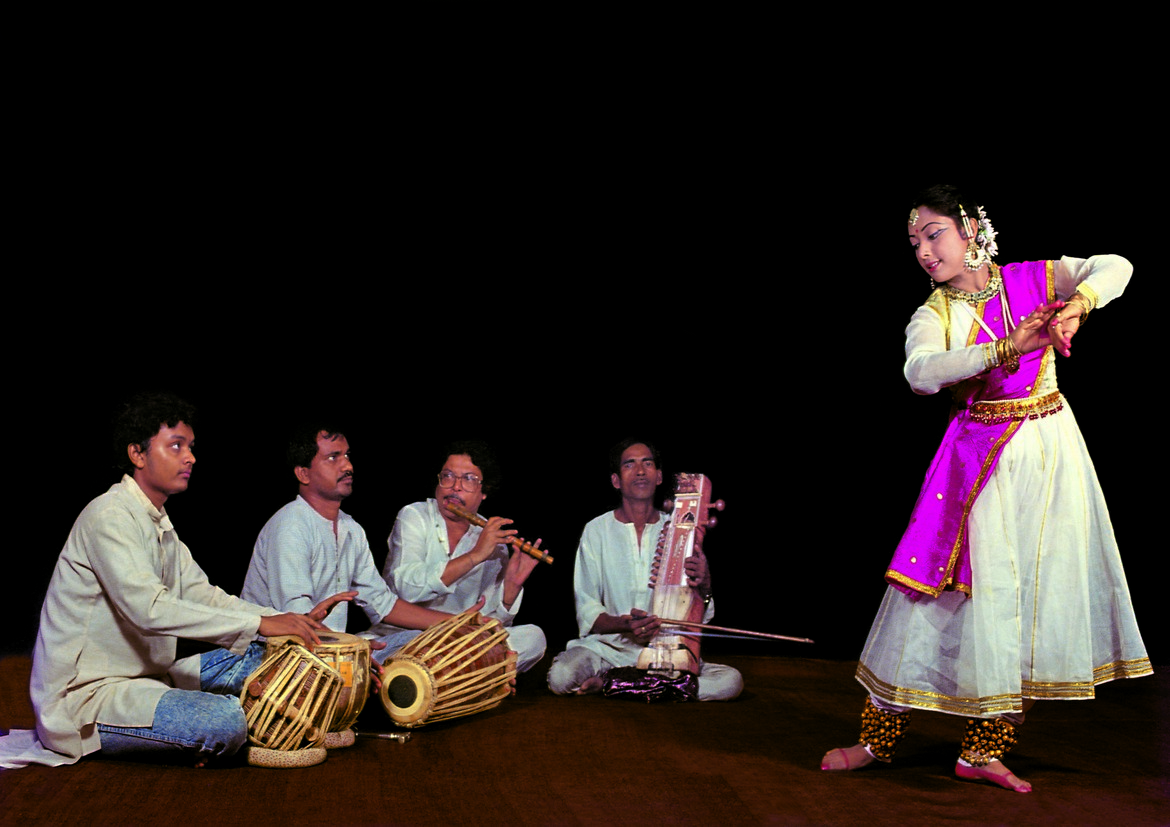
Kathak is one of the eight major forms of Indian classical dance. It is performed on stages around the world, in traditional solo recitals with live tabla, pakhawaj, sarangi and flute, and in new choreography for ensembles.

It is still taught the way it always has been: through the guru shishya parampara, one generation to the next.

A Kathak dancer in a Mughal-style angarkha performs with seated musicians playing tabla, pakhawaj, flute and sarangi
Vidushi Saswati SenView on Wikimedia Commons
Vidushi Saswati Sen in the Mughal-style angarkha, churidar and odhni, with tabla, pakhawaj, flute and sarangi. Source: NROER. CC BY-SA 4.0, via Wikimedia Commons.
Kathak dancers from an ensemble performing together on a dark stage
Aditi Mangaldas's ensembleWarsaw, 2007. View on Wikimedia Commons
Dancers from Aditi Mangaldas's ensemble performing in Warsaw, 2007. Photo: Dobromila. CC BY-SA 3.0, via Wikimedia Commons.
Where Ridhun fits in

Join the next generation

Pandit Birju Maharaj·Sri Murari Sharan Gupta·Ashmitha Gad·You

Every class at Ridhun is taught in this Lucknow tradition, by a teacher who learnt it from a disciple of Pandit Birju Maharaj.

Image credits

  1. Dancing girls from Malwa entertain Akbar. Unknown artist, Akbarnama, about 1590, Victoria and Albert Museum. Public domain. Wikimedia Commons
  2. Vajid Ali Shah. Engraving, 1872. Public domain. Wikimedia Commons
  3. Rumi Darwaza. Photo by Rishabhgpt, 2018. CC BY-SA 4.0. Wikimedia Commons
  4. Nautch dancers in India, about 1860 to 1870. Unknown photographer, Leiden University Library (KITLV). Public domain. Wikimedia Commons
  5. Pandit Birju Maharaj. Photo by Sudhanwa, 2012. CC BY-SA 3.0. Wikimedia Commons
  6. Kathak Performance (Vidushi Saswati Sen), 2014. Unknown photographer, source NROER. CC BY-SA 4.0. Wikimedia Commons
  7. Kathak (Aditi Mangaldas's ensemble, Warsaw). Photo by Dobromila, 2007. CC BY-SA 3.0. Wikimedia Commons

All images are real photographs, paintings and engravings, shown unaltered apart from scaling to fit the page. None are AI-generated.

Sources and further reading